



In This Article
- How bad is the skills shortage in Canada and the U.S.?
- What countries are getting it right, and why?
- How Trump’s policies are making the crisis worse
- Can AI save us—or will it widen the divide?
- What real solutions are needed to avoid collapse?
Why Canada and the U.S. Are Losing the Global Talent War
by Robert Jennings, InnerSelf.comLet’s address the pressing issue at hand: there are nearly a million job vacancies in Canada and over nine million in the United States. This is not a result of laziness or vacationing, but a dire shortage of people with the necessary skills. From trades to tech, nursing to education, the demand far exceeds the supply. Despite the large number of graduates, many lack the basic skills required for the jobs they seek.
This is not a problem of the future; it is a current, structural issue that is worsening. In Canada, 700,000 skilled tradespeople will retire by 2028. In the U.S., over 25% of the professional labor force is nearing retirement age. The completion rates for apprenticeships are alarmingly low. It's time to shift our focus from treating vocational education as a last resort to recognizing it as the foundation of a modern economy.
Other Countries Read the Memo
While North America still clings to its self-image as the pinnacle of innovation and economic leadership, countries like Germany, Singapore, and Australia have quietly moved past cheerleading and gotten to work. In Germany, the dual education system is not just a policy—it’s a cultural cornerstone. Students divide their time between traditional academics and hands-on apprenticeships, often sponsored by companies that train them in real-world environments.
The result? A skilled, job-ready workforce that doesn’t graduate with a mountain of debt and zero experience. The polytechnic system works hand-in-glove with industry demands in Singapore, constantly adjusting its programs to meet labor market trends. Australia, meanwhile, doesn't waste time with academic turf wars. When they identify a need, they launch fast-track micro-credential programs—no committee delays, no bureaucratic fog, just action.
These countries treat workforce development like a matter of national security—because it is. They’ve recognized that the strength of a nation isn’t just measured in GDP or stock prices but in whether it can build, staff, and sustain itself without imploding from within. North America, on the other hand, seems content to churn out marketing majors and data analysts. At the same time, critical sectors like construction, elder care, and skilled trades are left scraping the bottom of the barrel. Hospitals are short-staffed, infrastructure is crumbling, and employers are desperate. Yet we keep doubling down on the same outdated education model, expecting different results. That’s not a strategy—it’s a delusion.
The disconnect is staggering. In countries that have 'read the memo,' policy is driven by workforce realities and employer needs. In contrast, in the U.S. and Canada, it’s still dictated by prestige, inertia, and a century-old notion that academic degrees are the only path to prosperity. We continue to underfund vocational education, stigmatize the trades, and treat hands-on work like second-class labor—never mind that it’s the very labor holding our society together. While Germany produces engineers who can weld and code, we graduate business students who need a year of retraining to answer the phones at a help desk. This is not a pipeline. This is a cliff.
Then There’s the Trump Problem
Let’s not sugarcoat it: Donald Trump’s economic and immigration policies are like pouring gasoline on a dumpster fire—and then blaming the smell on someone else. During his first term, he didn’t just tighten the border; he took a sledgehammer to legal immigration, gutting the programs designed to bring in high-skill talent for sectors like tech, medicine, and construction. Now, he’s back with a vengeance, promising mass deportations and stricter limits on work visas, all under the cartoonish banner of “America First.” But America first to what? Self-destruction?
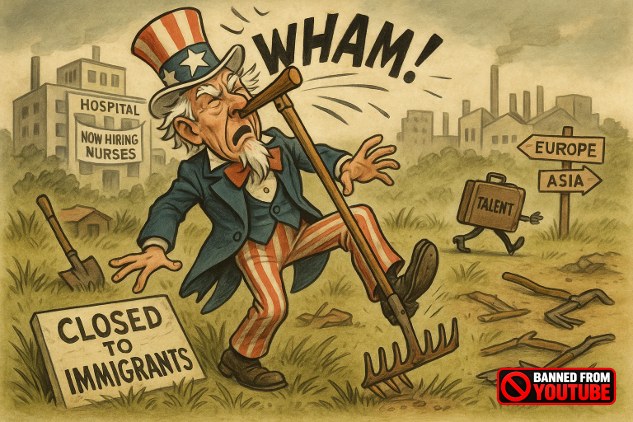
America doesn’t run on bravado. It runs on labor—real, skilled, hard-to-replace labor. You don’t build semiconductor factories with slogans. You don’t run a functioning hospital with Fox News soundbites. You're not protecting jobs when you tell the world’s best engineers, nurses, and coders that they’re no longer welcome unless they come from the “right” places or think the “right” way. You’re guaranteeing they go unfilled. Trump’s brand of populism may win applause at rallies. Still, it’s the equivalent of stepping on a rake in boardrooms, factories, and operating rooms—loud, embarrassing, and entirely self-inflicted.
Contrast that with Canada, where at least there’s an understanding—on paper—that immigration is an economic lifeline. But theory and practice are two different beasts. Canada’s points-based immigration system looks great from 30,000 feet, but it’s a bureaucratic nightmare up close. Internationally trained professionals—doctors, engineers, teachers—sit idle for months or years while a tangled web of provincial credentialing systems decides whether they’re “qualified enough” to practice skills they’ve been using for decades. The result? A nation with thousands of underemployed experts and a healthcare system crying out for help. It’s not racism; it’s red tape. But the outcome is just as senseless.
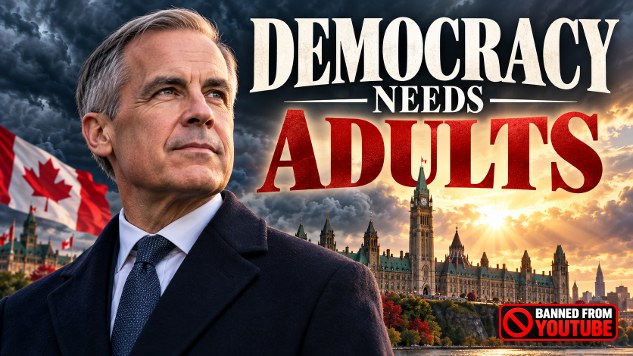
Enter Mark Carney—perhaps Canada’s best shot at avoiding the same fate. The former Governor of the Bank of Canada and the Bank of England understands how systems work—and, more importantly, how they fail. Carney speaks the language of markets and policy, not resentment and blame. As Prime Minister, one could imagine a pragmatic approach: immigration as workforce policy, credentialing reform as an economic strategy, and education tied to real-world outcomes instead of legacy structures. He may not inspire street parades, but Carney has the one thing missing from most leaders today—an actual plan tethered to reality.
Trump, meanwhile, is not a man with a plan—he’s a man with a mirror. His policies don’t address structural shortages or economic resilience; they pander to fear and nostalgia. He’s running on grievance, not governance. And in a world facing a demographic crunch, an AI revolution, and a collapsing middle class, that’s not just bad politics. It’s a death wish for any nation competing in the 21st century. The difference between Carney and Trump isn’t left versus right—it’s a functioning system versus a circus act. And when your economy's on fire, the last thing you need is a clown holding a flamethrower. Donald Trump is the political equivalent of America stepping on the rake it lazily left lying in its own front yard.
AI: Savior or Scalpel?
Now enter artificial intelligence—because, of course, there’s a new twist. AI has the potential to revolutionize learning, make education more adaptive, and even train workers faster. But without intentional design, it will do what tech often does: deepen inequality, automate mid-skill jobs, and concentrate wealth at the top. Suppose we let AI run wild without rethinking how we train, certify, and transition workers. In that case, we’re not solving the problem—creating a bigger one.
Already, employers are asking for real-world competencies over degrees. Micro-credentials are on the rise. So are boot camps and skill portfolios. But suppose governments don’t step in to ensure equity. In that case, we’ll recreate the same class divide—this time, turbocharged by algorithms and Silicon Valley’s latest “solution.”
Five Things We Must Do—Yesterday
First, we need to drag our apprenticeship systems into the 21st century. In Canada and the U.S., these programs are slow, underfunded, and designed for a bygone era. We should aim for fast, flexible, competency-based training—two years, not four. Second, it's time for a national framework recognizing micro-credentials and real-world experience. Learning happens in boot camps, on YouTube, and on the job—not just in classrooms. Third, we need to overhaul immigration so it works like a modern workforce tool, not a bureaucratic endurance test. Talent should be matched to needs immediately, not after years of paperwork and gatekeeping. Fourth, employers must be given serious incentives—not just tax breaks but public prestige—for investing in training their workforce. And finally, we have to tear down the wall between education and employment. Post-secondary programs should be co-designed with employers, not academics who haven’t left campus since 1993.
Because if we don’t act now, we’re not just looking at a labor shortage—we’re staring into the abyss of economic paralysis. Between aging populations, shrinking birth rates, and the disruptive force of AI, the number of unfillable jobs will only balloon. It’s not just that people aren’t coming. Increasingly, they’re leaving. American professionals are heading to Canada, Europe, Australia, and Asia—places that welcome skilled workers and value them. They’re tired of being overeducated, underemployed, and treated like disposable parts in a broken machine. Brain drain used to be a theoretical risk. Now, it’s a flight schedule.
But don’t worry—some still believe we can tax-cut our way out of it. Maybe if we just shovel a few more billions to corporate shareholders, the magical hand of the market will swoop in and train welders, build housing, and fix the nursing shortage. Or maybe, just maybe, it’s time to admit that ideology isn’t a strategy. Economies don’t run on vibes or slogans. They run on people. And if we don't invest in ours—and stop driving the best and brightest away—there won’t be a country left to save. But maybe a few more tax cuts for billionaires will do the trick. That always works, right?
jennings_bio
books_economy
Article Recap
The skills shortage across Canada and the U.S. is spiraling into a full-scale workforce crisis, worsened by aging populations, outdated apprenticeship systems, and anti-immigration policies. Countries like Germany and Singapore are adapting, while North America stalls. Add the destabilizing force of AI, and we’re staring down a major economic collapse unless urgent structural reforms are enacted now.
#SkillsShortage #WorkforceCrisis #AIandJobs #TalentWar #SkilledTrades #ApprenticeshipReform #GlobalWorkforce