
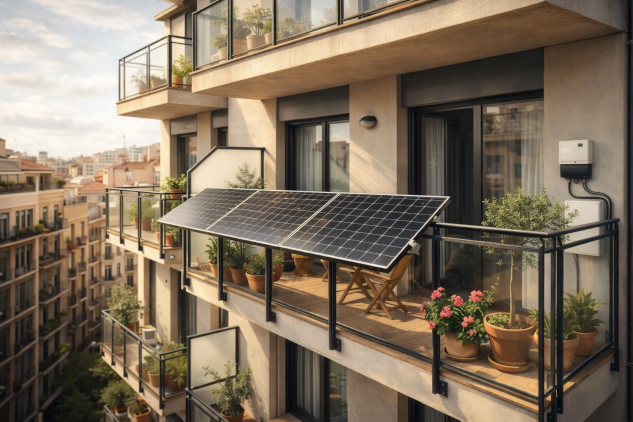
A three-hundred-dollar solar panel that plugs into a wall outlet can begin cutting your electricity bill the same afternoon you unbox it. No permit. No installer. No roof work. More than a million of these systems are already running in Germany, sold in supermarkets alongside kitchen appliances. In the United States, the same technology is running into a wall of utility regulations that were designed for a different era — and the collision tells you everything about who really controls your electricity.
In This Article
- How plug-in solar works and why it is different from traditional rooftop installation
- What Germany's million-unit rollout proves about safety and adoption
- Why electric utilities have a structural reason to slow this technology down
- How AI data centers are intensifying the collision between centralized and distributed power
- What regulatory change would be required to allow plug-in solar to reach its potential in the United States
There is a particular kind of disruption that existing industries fear above all others. Not the kind that requires a billion dollars and a decade of engineering to deploy. The kind that any ordinary person can buy, carry home, and plug in before dinner. That is what plug-in solar represents, and it explains why a technology that is already transforming energy consumption across Europe is moving through the American regulatory system at the pace of a permit application that nobody particularly wants to approve.
The Appliance That Generates Power
Plug-in solar systems are technically straightforward. A photovoltaic panel — typically producing between four hundred and eight hundred watts — connects to a small inverter that converts direct current from the panel into the alternating current your home runs on. That current feeds into your home's electrical circuit through a standard outlet. The power offsets electricity that would otherwise come from the utility. Your meter slows down. Your bill goes down. The system costs a few hundred dollars and installs in an afternoon.
What makes this different from conventional rooftop solar is not the physics. It is the barrier to entry. Traditional solar installation involves structural engineering assessments, permits, utility grid connection agreements, inspections, and installation crews. The average residential solar project in the United States takes months from decision to activation and costs tens of thousands of dollars. Plug-in solar collapses that process into something that resembles buying a window air conditioner. The technology is not complicated. The simplicity is the point, and the simplicity is the threat.
Germany Already Ran the Experiment
When utilities and regulators in the United States have concerns about plug-in solar, they often speak as though the technology is untested. It is not. Germany has more than one million of these systems installed. Many are mounted on apartment balconies, which is why the Germans call them Balkonkraftwerke, or balcony power stations. They are sold in hardware stores and supermarkets. They have their own product category, safety standards, and a registration system that takes about 5 minutes to complete online.
The German government and independent safety researchers have examined this technology under real-world conditions for years. The finding is that properly certified systems with microinverters that automatically shut off when the grid goes down do not pose meaningful safety risks. The concerns that American utilities raise — shock hazards, circuit overloads, backfeed during outages — are real engineering problems that German standards already solved. The solutions are present. They have been deployed at scale. They work. The argument that the United States needs years more study before proceeding is not an argument about safety. It is an argument about delay.
The Revenue Problem Utilities Do Not Like
Electric utilities operate on a model that has been essentially unchanged since the early twentieth century. They make electricity at big centralized plants, push it across a grid they own, and sell it to customers who have no choice. The revenue model is pure volume. Every kilowatt-hour somebody generates on their own balcony is one that never gets sold. Multiply that by ten million households, and you're not talking about a rounding error. You're talking about the whole premise starting to crack.
The numbers aren't complicated. Ten million homes each running a modest plug-in system adds up to six gigawatts. That's what several large power plants produce. Except this version is spread across ten million rooftops and balconies, and none of it belongs to a utility. That's the part that keeps people up at night in the corner offices. The revenue those ten million homes redirect away from utilities every month does not disappear. It stays in the pockets of the people who installed the panels. Utilities, naturally, would prefer a different outcome.
This is why the safety debate, while not entirely manufactured, is also not entirely honest. The same utilities that warn about the dangers of a 400-watt balcony panel have no objection to customers running clothes dryers, electric water heaters, or EV chargers that draw far more current. The asymmetry is instructive. Appliances that increase electricity consumption are welcome. Appliances that reduce it are a safety concern.
Regulatory Maze That Protects the Old Model
In the United States, connecting any generation source to the electrical grid — even a small one — typically requires an interconnection agreement with the local utility, a permit from the local authority having jurisdiction, and, in many cases, an inspection. These requirements were designed for large commercial and industrial solar installations where the engineering complexity genuinely warrants oversight. Applying them to a plug-in system that generates less power than a kitchen range is regulatory capture dressed up as public protection.
The cost of dealing with these requirements can easily double the effective cost of a plug-in solar system. More importantly, the time and complexity deter the renters, apartment dwellers, and moderate-income households who would benefit most from the technology. Utah became the first state to pass legislation specifically exempting small plug-in systems from complex interconnection rules. The result was immediate growth in adoption. Several other states are moving toward similar exemptions, but the process is slow, state-by-state, and subject to the same utility lobbying that produced the first barriers.
The AI Demand Surge Changes the Calculus
There is a new factor in this story that was not part of the energy debate five years ago. Artificial intelligence infrastructure is consuming electricity at a rate that is surprising even to the people building it. A single large AI data center can draw as much power as a small city. The expansion of AI computing capacity underway right now is projected to add tens of gigawatts of new electricity demand to the American grid within a decade. Utilities are planning to meet that demand with new generation capacity, much of it centralized, and they need the revenue projections to justify the investment.
This creates an awkward collision. On one side, you have distributed solar technology that allows households to reduce their electricity purchases and collectively offset gigawatts of demand. On the other hand, you have an industry that needs a growing demand to finance the grid expansion that AI requires. The utilities are not wrong that new infrastructure is needed. But the argument that distributed generation therefore needs to be slowed down is backwards. Households generating some of their own power reduce the strain on a grid already pushed to its limits by data centers. The math works in favor of more distributed generation, not less.
Energy Independence for People
One of the least-discussed aspects of plug-in solar is who it reaches that conventional rooftop solar cannot. Traditional solar is a homeowner technology. You need a roof you own, the right orientation, adequate structural strength, and enough capital or credit to finance an installation that typically costs fifteen thousand dollars or more, even after incentives. This means that the solar energy transition, as it has occurred in the United States, has largely benefited people who already own property and have access to capital. Renters, apartment dwellers, and lower-income households have been structurally excluded.
The panel doesn't kill the grid. It doesn't put a utility out of business. What it does, multiplied across ten million households, is nudge the money in a different direction — away from the meter and back toward the person paying it. Small shift in hardware. Bigger shift in who the system works for. That democratization of energy access is, depending on your perspective, either a social good worth accelerating or another reason to be nervous about a technology that threatens established revenue streams.
The Question Behind the Safety Question
Every major energy transition in American history has encountered resistance from the industries it threatened. The arrival of natural gas challenged coal. The arrival of coal challenged wood and whale oil before it. Each transition was slowed by a combination of legitimate technical concerns and less legitimate economic ones, and the pattern of distinguishing between the two is always the same: watch what the opposition does when the technical problems are solved. If the objections shift to new technical problems rather than disappearing, you are looking at economics dressed as engineering.
Plug-in solar's safety challenges are solvable and, in most cases, already solved. Microinverters that shut off during outages, listed and certified components, simple registration systems — none of this is beyond American engineering or regulatory capacity. Germany implemented it. Other European countries are following. The question the United States is actually debating is not whether the technology can be made safe. The question is whether the regulatory system will be reformed quickly enough to allow millions of households to begin generating their own power before the next round of electricity rate increases.
The panel doesn't threaten the grid. But ten million of them threaten something. Not the infrastructure — the revenue. The money that used to flow in one direction starts leaking back toward the people paying the bills. Small physics. Big politics. It is a political one, and the answer will say a great deal about whose interests the American regulatory system is actually designed to protect.
About the Author
 Robert Jennings is the co-publisher of InnerSelf.com, a platform dedicated to empowering individuals and fostering a more connected, equitable world. A veteran of the U.S. Marine Corps and the U.S. Army, Robert draws on his diverse life experiences, from working in real estate and construction to building InnerSelf with his wife, Marie T. Russell, to bring a practical, grounded perspective to life’s challenges. Founded in 1996, InnerSelf.com shares insights to help people make informed, meaningful choices for themselves and the planet. More than 30 years later, InnerSelf continues to inspire clarity and empowerment.
Creative Commons 4.0
This article is licensed under a Creative Commons Attribution-Share Alike 4.0 License. Attribute the author Robert Jennings, InnerSelf.com. Link back to the article This article originally appeared on InnerSelf.com
Recommended Books
The Grid: The Fraying Wires Between Americans and Our Energy Future
Anthropologist Gretchen Bakke traces the history, fragility, and politics of the American electrical grid, explaining why a system built for a twentieth-century energy model is struggling to accommodate the distributed, renewable future that is already arriving.
Reinventing Fire: Bold Business Solutions for the New Energy Era
Energy visionary Amory Lovins lays out a detailed roadmap for transitioning the American economy off fossil fuels entirely through efficiency and renewable energy, making the case that the transition is not only possible but economically advantageous.
Freeing Energy: How Innovators Are Using Local-Scale Solar and Batteries to Disrupt the Global Energy Industry from the Outside In
A former tech CEO examines how distributed energy is shifting power away from centralized utilities and into the hands of the people paying the bills.
Article Recap
Plug-in solar technology offers households a low-cost path to energy independence, but utility regulation designed for large installations is slowing adoption in the United States even as Germany's million-unit rollout demonstrates that the safety questions are already answered. As AI data centers drive electricity demand higher and rates continue to climb, the debate over balcony solar is increasingly a debate about who the energy system is built to serve.
#PlugInSolar #SolarEnergy #EnergyIndependence #BalconySolar #RenewableEnergy #ElectricUtility #SolarPanel #EnergyPolicy #CleanEnergy