
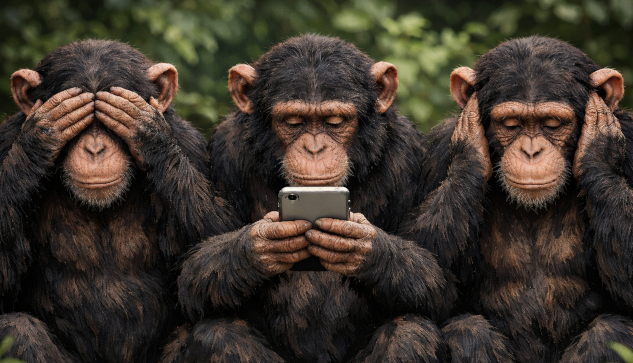
Picture the famous three wise monkeys, but instead of covering their eyes, ears, and mouth, one is staring into a glowing screen. We've traded the ancient wisdom of "see no evil, hear no evil, speak no evil" for something far more troubling: we've chosen to see, hear, and speak only what our devices show us.
In This Article
- How smartphones have replaced conscious moral choice with algorithmic filtering
- The transformation of ancient wisdom about avoiding evil into modern digital blindness
- Why echo chambers and personalized feeds are fragmenting our shared reality
- The psychological effects of constant digital stimulation on awareness and presence
- Practical strategies for reclaiming conscious attention in the digital age
The image has become a modern classic: a monkey hunched over a smartphone, completely absorbed in his screen. It's a clever twist on the ancient proverb, but it reveals something deeper than digital satire. We haven't lost our ability to see, hear, or speak. Instead, we've outsourced these fundamental human capacities to algorithms that decide what deserves our attention.
The original three wise monkeys represented a conscious choice about moral engagement with the world. Today's digital version shows us making a very different choice: to let technology filter reality for us. The question isn't whether we're blind, deaf, or mute. It's whether we're aware of who's controlling what we perceive.
From Ancient Wisdom to Modern Avoidance
The three monkeys originated in Buddhist and Confucian traditions, where they symbolized the discipline to avoid harmful thoughts, words, and actions. "See no evil, hear no evil, speak no evil" wasn't about ignorance. It was about conscious moral choice, the deliberate cultivation of wisdom over destructive impulses.
Somewhere along the way, Western culture flipped this meaning. The monkeys became symbols of willful ignorance, of people who refuse to acknowledge uncomfortable truths. We started using the image to criticize those who turn away from problems instead of addressing them.
But our digital age has created something entirely different. We're not avoiding evil or embracing ignorance by choice. We're letting sophisticated algorithms make those choices for us, often without realizing it's happening. The monkeys aren't covering their senses anymore because they don't need to. The screens are doing it for them.
The Attention Economy's Invisible Hand
Your smartphone isn't just a communication device. It's a sophisticated attention-capture machine, designed by some of the smartest engineers and psychologists in the world. Every notification, every colorful icon, every infinite scroll is calibrated to keep you engaged. Your attention has become the product being sold to advertisers.
This creates a fundamental shift in how we experience reality. Instead of actively choosing what to focus on, we react to whatever pings, buzzes, or appears in our feed. We mistake this constant stream of stimulation for awareness, but it's actually the opposite. True awareness requires the ability to choose what deserves our attention.
Consider how different this is from any previous form of media. A book waits patiently for you to open it. A newspaper doesn't follow you around demanding to be read. But your phone actively competes for your consciousness every waking moment, using psychological techniques originally developed to treat addiction.
The Echo Chamber Effect
The first monkey covered his ears to avoid hearing evil. Today, we don't need to cover our ears because algorithms ensure we mostly hear what we already agree with. Recommendation systems on social media platforms analyze our behavior and feed us content that matches our existing beliefs and preferences.
This creates what researchers call "filter bubbles" or "echo chambers." We're not hearing different perspectives because the system is designed to show us more of what we've already engaged with. If you click on political content that leans left, you'll see more left-leaning content. If you engage with conspiracy theories, you'll be fed more conspiracy theories.
The result is a fragmentation of shared reality. People living in the same city, reading the same platforms, can have completely different understandings of current events. We're not just avoiding evil anymore. We're living in separate worlds entirely, each convinced that our filtered version of reality is the complete truth.
This isn't an accident. Controversy and strong emotional reactions drive engagement, which drives advertising revenue. The algorithms learn that divisive content keeps people scrolling, so they serve up more division. We end up hearing plenty, but it's carefully curated to confirm what we already believe while amplifying our fears and frustrations.
The Silencing of Nuanced Discourse
The second monkey covered his mouth to avoid speaking evil. In our digital age, we face a more complex challenge. Social media encourages us to speak constantly, but it shapes how we speak in ways that actually diminish meaningful communication.
The format of most social platforms rewards quick, emotional reactions over thoughtful responses. Complex ideas get reduced to soundbites, memes, and reaction emojis. Nuanced positions that acknowledge multiple perspectives get less engagement than polarizing statements that trigger strong reactions.
Many people report feeling pressure to self-censor, not because they want to avoid speaking evil, but because they fear the social consequences of expressing unpopular opinions. Others find themselves performing opinions they don't fully believe, crafting posts for likes rather than authentic expression.
Perhaps most concerning is the rise of passive consumption over active participation. Many people scroll through endless content, reacting with hearts and thumbs-up but rarely engaging in the kind of sustained dialogue that builds understanding. We're speaking constantly but saying less and less of substance.
Digital Blindness in Plain Sight
The third monkey covered his eyes to avoid seeing evil. We don't cover our eyes anymore because we're constantly looking at screens. But this constant visual stimulation can create its own form of blindness.
When we walk down the street staring at our phones, we miss the subtle social cues, natural beauty, and environmental awareness that our ancestors took for granted. We see more images in a single day than previous generations saw in months, but we often process them so quickly that nothing makes a lasting impression.
This creates what researchers call "continuous partial attention." We're always somewhat aware of multiple information streams, but we're rarely fully present to any single experience. We take photos of our meals but don't taste them mindfully. We document our experiences but don't fully live them.
The irony is that we have access to more visual information than any humans in history, yet many people report feeling disconnected from the physical world around them. We can see what's happening on the other side of the planet instantly, but we miss what's happening in our own neighborhoods.
The Psychological Toll of Digital Overwhelm
This constant stimulation isn't just changing how we think. It's changing how we feel. Anxiety rates have skyrocketed, particularly among young people who've grown up with smartphones. Depression, despite increased awareness and treatment options, continues to rise in developed countries.
Part of this stems from the comparison culture that social media enables. We're constantly seeing curated highlights of other people's lives, which makes our own ordinary moments seem inadequate by comparison. But there's also something deeper happening.
Humans evolved to deal with immediate, concrete challenges in small social groups. Our brains aren't designed to process global catastrophes, political crises, and social outrage 24 hours a day. When we're constantly exposed to problems we can't directly solve, it creates a sense of helplessness and overwhelm.
The attention economy profits from keeping us in a state of heightened arousal. Calm, content people don't click as much. So the platforms are incentivized to show us content that provokes strong emotional reactions, even when those emotions are negative.
The Power Behind the Screen
Understanding our digital monkey problem requires recognizing who benefits from our distraction. The largest technology companies in the world have built business models that depend on capturing and monetizing human attention. They employ teams of neuroscientists, behavioral economists, and data scientists to make their products as engaging as possible.
This isn't necessarily malicious, but it creates a fundamental conflict of interest. What's good for these companies' bottom lines isn't always what's good for individual users or society as a whole. They succeed when we're scrolling, clicking, and engaging, regardless of whether that engagement improves our lives.
Most users have no idea how sophisticated these persuasion systems have become. We experience the results, the compulsive checking and endless scrolling, but we don't see the invisible architecture designed to create those behaviors. It's like being in a chess game where we can see our own moves but not our opponent's strategy.
This creates what some researchers call "digital feudalism," where a small number of companies control the information landscape that shapes how billions of people see the world. The power to determine what gets attention is the power to influence thoughts, emotions, and ultimately actions on a massive scale.
Historical Context and What Makes This Different
Every new communication technology has sparked concerns about its impact on human consciousness. Socrates worried that writing would weaken memory. Critics feared that novels would corrupt young minds. Television was supposed to turn our brains to mush.
Some of these concerns proved overblown, but others were prescient. Television did change how we consume information and entertainment, generally in ways that made us more passive. Radio enabled new forms of propaganda and mass persuasion. Each medium shaped not just what we knew, but how we thought about what we knew.
What makes our current digital transformation different is its scope, speed, and personalization. Previous mass media broadcast the same content to everyone. Digital platforms create individualized information environments tailored to each user's psychology. This is unprecedented in human history.
The speed of change also matters. Television took decades to achieve widespread adoption. Smartphones and social media platforms reached billions of users in just a few years, faster than society could develop norms and wisdom about how to use them wisely.
Reclaiming Conscious Attention
Recognizing the problem is the first step toward reclaiming our monkey minds. We need to remember that we have choices about how we engage with digital technology. The current situation isn't inevitable, and small changes in how we use these tools can create significant improvements in our awareness and well-being.
Digital minimalism offers one approach: being more intentional about which technologies we use and how we use them. This might mean turning off non-essential notifications, setting specific times for checking social media, or choosing to engage deeply with fewer information sources rather than skimming many.
We can also practice what might be called "algorithmic resistance." This means consciously seeking out perspectives that challenge our existing beliefs, following news sources with different editorial perspectives, and engaging with content that helps us understand rather than content that simply confirms our biases.
Perhaps most importantly, we need to rebuild our capacity for sustained attention and deep reflection. This might mean reading books instead of articles, having long conversations instead of quick text exchanges, or simply spending time in nature without any digital devices.
The goal isn't to reject technology entirely, but to use it more consciously. We want to be the ones making choices about what deserves our attention, rather than letting algorithms make those choices for us.
The Choice Behind the Screen
The image of the three digital monkeys is powerful because it reveals a truth about our current moment. We're not victims of technology, but we're not fully in control either. We're somewhere in between, making choices within systems designed to influence those choices in particular directions.
The ancient wisdom of the three monkeys was about conscious moral engagement with the world. The modern challenge is similar but more complex. We need to develop new forms of wisdom about how to navigate an information environment that's designed to capture and manipulate our attention.
This means learning to see the systems that shape our perception, to hear perspectives that challenge our assumptions, and to speak in ways that build understanding rather than division. It means reclaiming our agency in a world of powerful algorithms and attention merchants.
The monkeys in the modern image aren't forced to stare at their screens. They're choosing to do so, moment by moment, decision by decision. Understanding that we have choices, and learning to make those choices more consciously, might be the beginning of wisdom in the digital age. The question isn't whether we'll use these powerful tools, but whether we'll learn to use them in ways that serve our deepest values and highest aspirations.
About the Author
 Robert Jennings is the co-publisher of InnerSelf.com, a platform dedicated to empowering individuals and fostering a more connected, equitable world. A veteran of the U.S. Marine Corps and the U.S. Army, Robert draws on his diverse life experiences, from working in real estate and construction to building InnerSelf with his wife, Marie T. Russell, to bring a practical, grounded perspective to life’s challenges. Founded in 1996, InnerSelf.com shares insights to help people make informed, meaningful choices for themselves and the planet. More than 30 years later, InnerSelf continues to inspire clarity and empowerment.
Creative Commons 4.0
This article is licensed under a Creative Commons Attribution-Share Alike 4.0 License. Attribute the author Robert Jennings, InnerSelf.com. Link back to the article This article originally appeared on InnerSelf.com
Recommended Books
Digital Minimalism
Cal Newport explores how to live better in a world of constant connectivity by being more selective about digital technologies. He provides practical strategies for reducing digital clutter and rediscovering the value of solitude and deep work.
The Shallows What the Internet Is Doing to Our Brains
Nicholas Carr examines how internet use is changing the way our brains process information, potentially diminishing our capacity for deep reading and contemplation. This groundbreaking work explores the neurological implications of our digital habits.
Amusing Ourselves to Death
Neil Postman's prescient analysis of how television transformed American culture provides crucial context for understanding our current digital dilemmas. His insights about entertainment-based media remain remarkably relevant to social media and smartphone culture.
Article Recap
Our digital age has transformed the ancient wisdom of "see no evil, hear no evil, speak no evil" into unconscious algorithm-driven filtering of reality through smartphones and social media. This digital transformation creates echo chambers, reduces nuanced discourse, and diminishes our conscious awareness of the world around us, requiring intentional strategies to reclaim conscious attention and meaningful engagement.
#DigitalMinimalism #SmartphoneAddiction #SocialMediaEffects #AlgorithmicBias #EchoChambers #ConsciousAttention #DigitalWellbeing #TechnologyAndSociety #MindfulTechnology